UPHILL: Sierra Nevada Fire Rescue
 ▶ PLAY
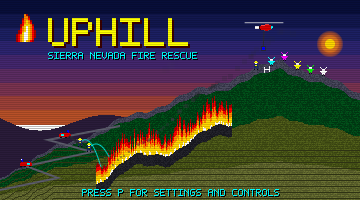
Late August on the mountain above Lanjarón, a small town on the south side of the Sierra Nevada in southern Spain. A fire has started low down in the barranco, the dry stony gully below the farm terraces, and the wind is pushing it up the slope towards eight villages.
You fly the one helicopter. It can be fitted with a water bucket or with passenger seats, and changing between them means landing back at base and losing time you may not have. That is the whole game: the aircraft you need to fight the fire is the aircraft you need to lift people off the ridge.
Free, no advertising, no account, nothing collected about you. It loads once and then runs offline. Best with sound on, and it needs a keyboard.
- Flying. Scoop from the Embalse de Béznar, the reservoir in the valley, and drop on the fire. Or fit the seats and lift people off the assembly point on the shoulder of the Cerro del Caballo, the peak above the town.
- Ordering the evacuation. Too early and the tight bends on the road jam with cars. Too late and people are still indoors when the fire arrives. You get one go at the timing.
- Commanding the ground crews. Fire engines are road bound. You give each one a tactic and a place, and it works without you until something changes.
There is no quota and no percentage to clear. The standard is every single person, on every difficulty. What separates a pass from a distinction is how much of the mountain and how many buildings you kept as well.
The fire is a simulation rather than a script, and most of what it does comes from how fire actually behaves on a slope.
- Fire climbs about three times faster than it burns downhill. Flames lean into the slope above them, drying and preheating the fuel before they reach it. That single fact is why the villages are in danger and why the people escaping run uphill anyway: the road is the thing that kills them, not the flame front.
- Flame length decides what a crew may do. The game uses the standard wildland bands. Below about 1.2 metres a crew can work the flame edge directly. Above about 3.4 metres nothing can stop the head of the fire, and an engine ordered onto it will refuse and work the flank instead.
- Crews follow LCES. Lookouts, communications, escape routes and safety zones: the doctrine that keeps a crew from being trapped. They watch the fire and the road behind them, and when either is threatened they say so and withdraw, whether or not you agree. You can order them to hold. It is sometimes the wrong call.
- The acequias are real. Those thin channels running across the slope are the stone irrigation ditches cut along the contours by the Moors, still carrying snowmelt across the hillside today. Fire will not cross running water, so they work as firebreaks, and the engines draw from them. The highest houses sit above the last channel, which is exactly why the helicopter matters up there.
- Roads do not burn, but they close. Tarmac has no fuel. A road is shut by flame in the ground beside it, and once the fire has passed you can drive the black.
Where it simplifies, it simplifies openly. One mountain, one afternoon, a fire model on a grid of cells rather than a physics package, and a helicopter that is easier to fly than the real thing.
In the nineteen eighties a cousin started writing a game on a ZX Spectrum: a tower block on fire, people on the roof, one helicopter to lift them off. I do not think he ever finished it. I never forgot it.
Years later I stayed at Cortijo del Cura, a house on the mountain above Lanjarón, and watched a fire burning across the Béznar valley. The two things turned out to be the same game. The tower block became a mountain, the roof became a ridge, and the helicopter kept its problem: it can only carry one thing at a time.
| Key | What it does |
|---|---|
| W A S D or arrows | fly the helicopter |
| E (hold) | scoop over the reservoir, load people at the white H, unload and refuel at the base pad |
| SPACE | release the water. The dashed ring shows where it will land, wind included |
| B | change between the water bucket and the seats. Base pad only, and it takes time |
| V | order the general evacuation. Once |
| P | pause and open the control dashboard, where the ground crews are commanded |
| M H R ESC | mute, help, restart, incident list |